How to Write SEO Content in 2025
What still works, what doesn’t, and what’s next in content strategy
Back in 2015, if you wrote a 500-word blog post and stuffed your main keyword ten times, you were likely to rank. Fast forward a decade, and we’ve entered a new era of content creation, and the rules have changed. SEO content writing in 2025 is no longer about gaming algorithms; it’s about writing for real people while respecting how search engines understand language.
In this article, I’ll break down how modern SEO content works, what Google rewards now, and how you can write content that ranks and gets read. This isn’t theory. It’s based on what I’ve seen working across multiple industries, from tech startups to service businesses trying to build their authority online.
Search Has Grown Up: Why Content Needs to Be Smarter Now
Let’s start with the elephant in the room: AI.
With AI-generated content flooding the web, Google has doubled down on quality. The latest updates show a strong shift toward rewarding content that is:
Helpful
Accurate
Clearly written by a human with experience or expertise
One client of mine, a small SaaS company, lost nearly 40% of its traffic after publishing a series of low-effort AI-generated blogs in 2024. When we rewrote those same articles with a clear point of view, added original research, and gave users answers backed by experience, their traffic started climbing again.
This proves that in 2025, seo content writing 2025 isn’t about producing more; it’s about writing smarter.
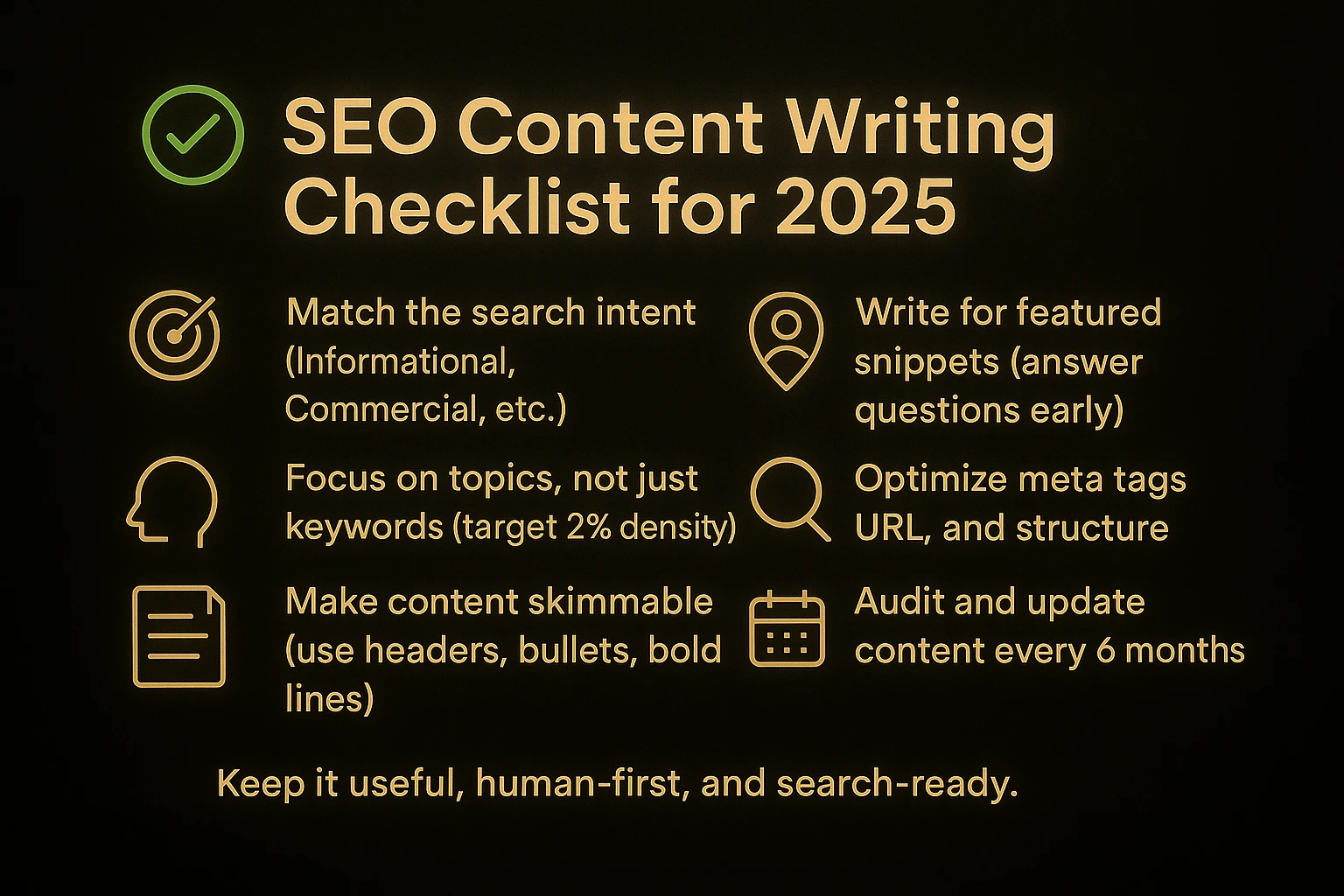
1. Focus on Topics, Not Just Keywords
A few years ago, keyword density ruled everything. Today, that approach is outdated. Search engines understand context, related terms, and how humans phrase queries.
Let’s say your topic is "remote hiring in tech." The old way would focus on repeating that phrase repeatedly. The new way looks more like this:
Answer related questions like “how do I hire remote developers?”
Include words and phrases people associate with the topic, like “distributed teams,” “timezone overlap,” and “vetting skills online.”
Google’s NLP (Natural Language Processing) has matured. It can now tell if an article feels complete. This means the smartest thing you can do is write a piece that truly covers a topic in-depth, using natural language, not robotic keyword stuffing.
2. Talk Like a Human. Write Like an Expert.
In 2025, the best content sounds like a conversation between a smart friend and someone trying to learn. You don’t need to "demonstrate authority" with big words or formal tones. What you do need is clarity, structure, and insight.
For example, I once wrote a blog for a cybersecurity firm explaining how phishing scams target employees. Instead of using technical language, I told a true story about how a client’s team nearly got scammed by a fake invoice email. That story hooked readers. Then I explained how to prevent it in plain English. The result? It ranked on page one and stayed there for over six months.
Your takeaway:
👉 Use examples, real situations, and explain things clearly.
👉 Skip buzzwords. People don’t want fluff, they want answers.
3. Structure Content for Search and Humans
Google and readers both love structure. In 2025, here’s what works best:
Title Tag (under 60 characters): Clear and to the point
Meta Description (under 160 characters): Summarize the value
H2 and H3 subheadings: Use these to split the article into useful sections
Short paragraphs: 2–3 lines max — no walls of text
Bullet points and lists: Easy to skim
Internal links: Point to other useful pages on your site
External links: Cite trustworthy sources when quoting stats or facts
If you’re writing a post that’s 1200–1500 words, you should have at least 5–7 subheadings to make it easy to read and digest.
4. Match the Intent Behind the Search
Not every reader wants the same thing. Some are looking for quick answers. Others want deep insights. Understanding search intent is now non-negotiable in seo content writing 2025.
There are generally four types:
Informational (e.g., "how to write SEO content")
Navigational (e.g., "Ahrefs blog")
Transactional (e.g., "best SEO agency 2025")
Commercial research (e.g., "Semrush vs Ahrefs")
If you write an in-depth guide for someone who just wants a quick definition, they’ll bounce. That tells Google your page wasn’t helpful. But if you match the tone and depth to the query, users stay longer, scroll more, and click through, which all help your rankings.
5. Optimize, But Don’t Obsess
Let’s talk about the technical side. Yes, you still need to:
Include your main keyword (aim for around 2% usage in a 1200-word article, like this one)
Use your keyword in the title, URL, first paragraph, and at least one subheading
Add relevant alt text to images
Write a proper meta description
But beyond that, don’t over-optimize.
One of the worst mistakes I see is trying to “force” keywords into every sentence. It sounds awkward and hurts the user experience. Google notices when content is unnatural.
Instead, focus on writing naturally. Sprinkle in related phrases, synonyms, and contextually relevant ideas.
6. Write for Zero-Click Searches Too
Not every click equals success. Google now displays answers within the results, things like featured snippets, "People Also Ask," and knowledge panels.
To earn these spots:
Use direct answers within your content
Structure with question-and-answer formats
Keep answers short (40–50 words is ideal for featured snippets)
Example:
Q: What is SEO content writing in 2025? A: It’s the process of creating useful, well-structured, and user-focused articles that help search engines understand and rank your content effectively.
Boom, that’s snippet-friendly. Do that throughout your article, and you’ll improve your chances of showing up even without a click.
7. Add Unique Value, Always
It’s tempting to copy what the top results are doing and just tweak a few words. That doesn’t work anymore.
Ask yourself: Why would someone read this article over the others already ranking?
Try to add:
A real story
A case study
A unique data point
A hands-on tip based on your actual experience
When I write about SEO, I often include screenshots from my own Google Search Console or case studies from clients (with permission). This builds trust. It also shows that the article isn’t just theory; it’s based on something real.
In a nutshell..
SEO in 2025 rewards those who respect both the reader and the algorithm. SEO content writing 2025 is about clear thinking, not clever tricks.
Yes, you still need keywords. Yes, structure matters. But more than anything, your content should answer questions in a way only you can. Share your experience. Write with purpose. Respect your readers' time.
Search engines are getting smarter. So should we.
Frequently Asked Questions

Author: Abdullah Habib
Abdullah Habib is a results-driven Digital Marketer specialising in SEO, content strategy, and online growth. He blends creativity with data to help brands thrive in the digital space.